The MQ135 is a semiconductor gas sensor widely used for detecting air quality and harmful gases. It belongs to the MQ sensor family, which uses SnO₂ (tin dioxide) as the sensing material.
Function: Gas Sensor
Package: 6 Pin Module type
Manufacturer: Futurlec
Image:
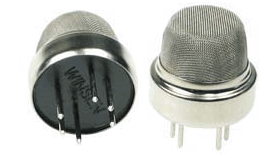
Description
The MQ135 is a semiconductor gas sensor designed to detect air quality-related gases such as NH3, NOx, alcohol, benzene, smoke, and CO2 equivalents in indoor environments. It employs a heated SnO2 sensing element that offers high sensitivity, wide detection range, and stable response characteristics. This sensor is commonly used in air quality monitors, smart home systems, and environmental sensing projects.
Features
- Wide detecting scope
- Fast response and high sensitivity
- Stable and long operational life
- Simple drive circuit
- Wide detection range for indoor air quality monitoring
- SnO2 semiconductor sensing element
- Good repeatability and long-term stability
- Suitable for continuous gas monitoring
Principle of Operation
The MQ-135 sensor works on the chemiresistor principle:
1. Sensing Material: SnO₂ changes its resistance when exposed to oxidizing or reducing gases.
2. Gas Detection: The sensor’s resistance decreases with the presence of target gases.
3. Heater Element: Built-in heater maintains the sensing material at the required working temperature (~200–300°C) to improve reaction and sensitivity.
4. Output Signal: Analog voltage or resistance change, which can be read by a microcontroller ADC or converted to PPM (parts per million) with calibration.
MQ135 Pinout

1. Gas sensing : layer SnO2
2. Electrode : Au
3. Electrode line : Pt
4. Heater coil : Ni-Cr alloy
5. Tubular ceramic : Al2O3
6. Anti-explosion network : Stainless steel gauze (SUS316 100-mesh)
7. Clamp ring : Copper plating Ni
8. Resin base : Bakelite
9. Tube Pin : Copper plating Ni
Design Notes
- Allow an adequate preheating period before taking measurements for maximum accuracy
- Use a suitable load resistor to optimize sensitivity for the target gas concentration
- Avoid exposure to silicone vapors and corrosive gases that may damage the sensing element
- Ensure good airflow around the sensor during operation
- Periodic calibration is recommended for quantitative air quality measurements
Applications
They are used in air quality control equipments for buildings/offices, are suitable for detecting of NH3, NOx, alcohol, Benzene, smoke, CO2 , etc.
1. Air Quality Monitoring: Indoor/outdoor air quality sensors, smart home air purifiers
2. Industrial Safety: Detecting harmful gases in factories
3. Environmental Monitoring: Measuring urban pollution, CO₂, NOx levels
4. Educational Projects: Used in DIY electronics to demonstrate gas detection
5. Vehicle Emissions Monitoring: Detecting exhaust gases and VOCs
Comparison with Other MQ Sensors
| Sensor | Target Gas | Sensitivity | Application |
|---|---|---|---|
| MQ-2 | LPG, H₂, Methane, Smoke | High for flammable gases | Gas leak detection, fire alarms |
| MQ-6 | LPG, Butane, Propane | High for LPG/Propane | Home gas detectors |
| MQ-7 | CO (Carbon Monoxide) | High for CO | CO detection, air quality |
| MQ-135 | NH₃, NOx, CO₂, Benzene, Smoke | High for harmful air gases | Air quality monitoring, pollution detection |
Other data sheets are available within the file: MQ-135
MQ135 Datasheet PDF Download


List of search results related to this post
| Part number | Description |
| MQ-4 | Gas Sensor – Hanwei |
| MQ-5 | Gas Sensor – Winsen |
| MQ6 | Gas Sensor |
| MQ-136 | Gas Sensor – Hanwei |